Service AI is rapidly reshaping how businesses deliver support, handle requests, and take care of customers and employees. By leveraging service AI solutions, organizations can respond faster, solve more issues automatically, and free human teams to focus on higher‑value work. From AI-powered call center use cases to practical AI tools for growing businesses, the result is a smoother experience for customers and a more efficient, scalable operation for companies.
Businesses seeking to handle large-scale operations efficiently can adopt innovative computing systems that enable distributed processing across multiple devices simultaneously. These solutions reduce processing times dramatically and support faster, smarter customer service workflows. IT managers can also consult detailed supercomputer technology reviews and performance benchmark guides to select hardware capable of managing high-demand workloads reliably.
Marketing strategies gain a competitive edge when companies apply AI-driven customer engagement techniques that optimize messaging and interaction quality. Additionally, practical marketing runners guides with step-by-step automation implementation tips help teams incorporate AI tools without losing the human touch in campaigns.
Financial planning and management benefit from top business financial resources providing guidance on budgeting, ROI measurement, and technology adoption. Using these insights, organizations can align AI initiatives with financial objectives, ensuring sustainable growth while maximizing efficiency.
Integrating service AI into day-to-day operations allows companies to automate repetitive tasks, reduce human error, and focus on strategic initiatives. By combining intelligent automation with human insight, organizations can deliver faster, more personalized, and highly efficient support, creating a seamless experience for both customers and employees.
Top 10 Service AI Contact Center Solutions for Modern Businesses
In today’s competitive business environment, choosing the right contact center solution can dramatically improve customer experiences, streamline operations, and maximize efficiency. Service AI is at the core of modern contact centers, providing automation, predictive analytics, and intelligent workflows that empower agents to handle inquiries more effectively. Here are the top 10 service AI contact center solutions that businesses rely on:
1. Bright Pattern: AI Contact Center Platform
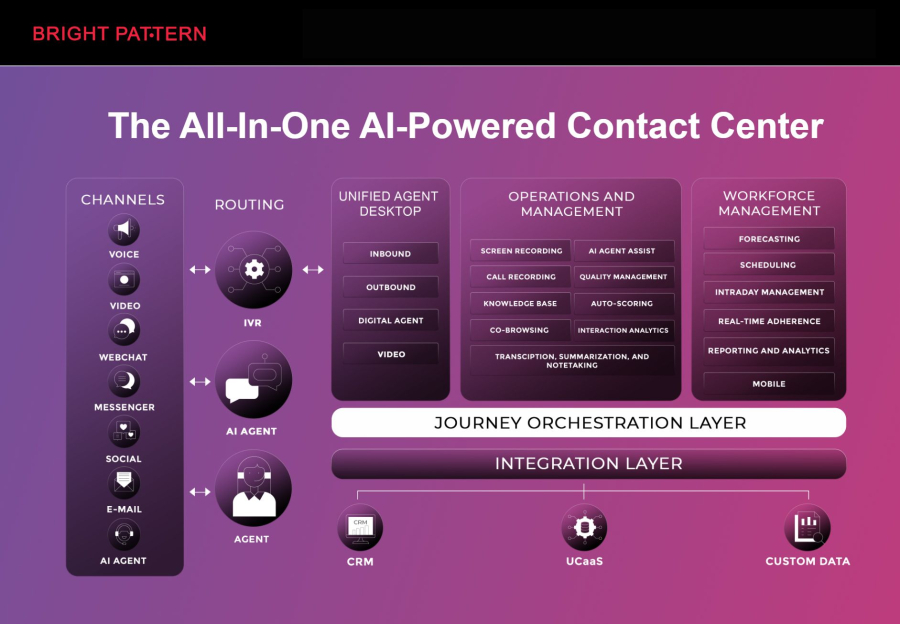
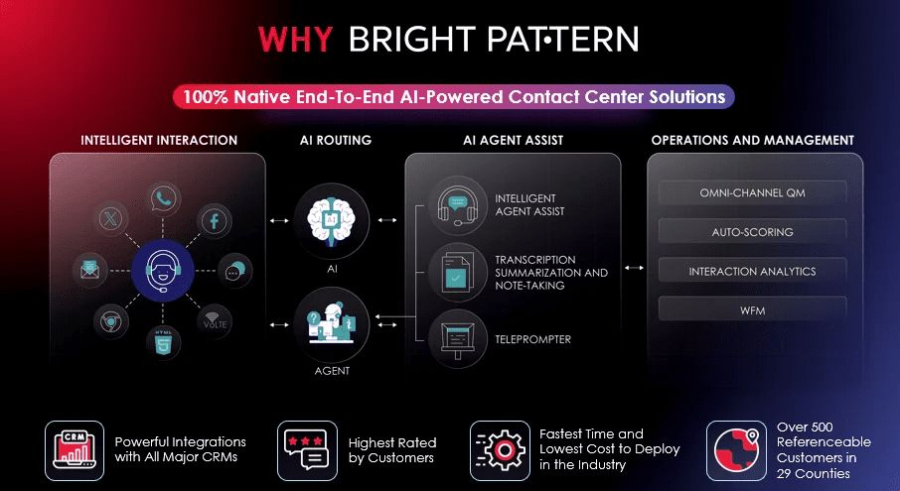
Bright Pattern leads the industry with a comprehensive AI-powered contact center solution designed to improve customer support and agent efficiency. Its platform combines advanced service AI capabilities with omnichannel communication, making it easy for businesses to deliver seamless experiences across voice, chat, email, SMS, and social media.
Key features include:
- AI-driven routing and predictive engagement to connect customers with the right agent
- Intelligent automation for repetitive tasks and inquiries
- Integration with CRM systems and business applications
- Real-time analytics and reporting for performance optimization
- Omnichannel support for consistent customer experiences
Bright Pattern’s service AI solutions help contact centers reduce response times, improve first-call resolution, and empower agents to focus on higher-value interactions. Businesses using Bright Pattern can leverage AI not just for automation but also for insights that drive strategic decisions.
2. Genesys Cloud CX
Genesys Cloud CX offers AI-enabled customer experience solutions, including predictive routing, chatbots, and analytics to enhance contact center performance.
3. Five9 Intelligent Cloud Contact Center
Five9 combines service AI with automation to streamline call handling, optimize agent workflows, and improve customer satisfaction.
4. NICE inContact CXone
NICE inContact CXone delivers AI-powered omnichannel routing, workforce optimization, and analytics for scalable and efficient contact center operations.
5. Talkdesk CX Cloud
Talkdesk provides AI-driven call center solutions that enhance agent productivity, automate processes, and deliver insights for better customer engagement.
6. RingCentral Contact Center
RingCentral’s AI contact center platform integrates communication channels and intelligent automation for improved customer service and operational efficiency.
7. Avaya OneCloud CCaaS
Avaya OneCloud uses service AI to enable predictive routing, agent assist tools, and real-time analytics across multiple communication channels.
8. 8x8 Contact Center
8x8 Contact Center leverages AI for speech analytics, chatbots, and workforce optimization, helping organizations deliver faster and more personalized customer support.
9. Cisco Webex Contact Center
Cisco Webex Contact Center combines AI-powered routing, analytics, and omnichannel support to optimize agent performance and enhance customer experiences.
10. Zendesk AI for Support Centers
Zendesk integrates AI with its support platform to automate responses, analyze customer data, and provide actionable insights for service improvement.
What Is Service AI?
Service AIrefers to the use of artificial intelligence technologies to improve how services are delivered and managed. This can apply to customer support, IT help desks, HR service centers, field service, and any other function where people request help or information.
Common technologies that power Service AI include:
- Natural language processing (NLP)to understand questions written or spoken in everyday language.
- Machine learningto recognize patterns, recommend solutions, and improve over time.
- Conversational interfacessuch as chatbots and virtual agents that interact with users 24/7.
- Intelligent searchthat finds the most relevant answers from knowledge bases and documentation.
- Automation and workflowsthat route, categorize, and resolve requests without manual effort.
When these capabilities are combined, organizations can deliver service that is faster, more consistent, and available wherever customers or employees need it.
The Business Benefits of Service AI
Investing in Service AI is not just about technology; it is about unlocking measurable business value. When designed and implemented thoughtfully, Service AI can deliver benefits across revenue, cost, and experience.
1. Faster Responses and 24/7 Availability
Customers and employees expect instant help. Service AI meets that expectation by providing:
- Always‑on supportthat responds outside business hours, across time zones, and during peak periods.
- Instant answersfor common questions, eliminating wait times in queues or on hold.
- Automatic routingso complex issues reach the right expert without manual triage.
This significantly reduces perceived wait times and makes support feel more responsive and reliable.
2. Higher Customer and Employee Satisfaction
Well‑implemented Service AI improves satisfaction by making service interactions simpler and more predictable. It can:
- Provideconsistent, accurate answersdrawn from approved knowledge sources.
- Personalize responsesusing context like past interactions, preferences, or account data.
- Offerproactive helpby suggesting solutions before a user even submits a ticket.
When people get quick, clear support without repeating themselves or being transferred multiple times, they tend to rate the experience much more positively.
3. Reduced Service Costs Without Sacrificing Quality
Many service organizations are under pressure to do more with limited resources. Service AI helps by:
- Automating repetitive requestssuch as password resets, order status checks, or policy questions.
- Deflecting ticketsfrom live agents by resolving them through self‑service channels.
- Supporting higher agent productivitywith suggestions, templates, and quick access to information.
Over time, this allows teams to handle more volume with the same or fewer resources, while reserving human effort for complex, relationship‑driven interactions.
4. Empowered Service Teams
Service AI is often misunderstood as a replacement for human agents. In reality, the most successful implementations treat AI as a partner that enhances human work. For example, AI can:
- Suggest answersto agents based on similar past tickets, reducing research time.
- Summarize long conversationsso new agents can quickly understand context.
- Highlight urgency or sentimentto help agents prioritize and respond appropriately.
Instead of spending their day on repetitive tasks, agents can focus on resolving complex issues, building customer loyalty, and learning new skills. This can improve morale and reduce burnout in service roles.
5. Better Insights and Continuous Improvement
Every interaction with Service AI generates valuable data. Organizations can use this information to:
- Identifycommon issues and root causesthat may require product or process changes.
- Spotknowledge gapswhere documentation needs to be created or updated.
- Measureservice performanceacross channels and customer segments.
These insights help leaders make smarter decisions about where to invest and how to continuously improve the service experience.
Key Use Cases for Service AI
Service AI is versatile and can be deployed across multiple functions. Below are some of the most impactful use cases.
1. Customer Support and Contact Centers
This is one of the most mature and visible applications of Service AI. Typical capabilities include:
- AI‑powered chatbotson websites, mobile apps, and messaging channels.
- Virtual phone agentsthat understand natural speech and guide callers.
- Smart routing and triagethat sends complex issues directly to skilled agents.
These tools reduce call volumes, cut handle times, and make it easier for customers to find help in the channel they prefer.
2. IT Service Management (ITSM)
In IT departments, Service AI supports employees and internal customers by:
- Resolvingcommon technical issuessuch as connectivity or software questions.
- Automatingservice requestslike access provisioning or equipment orders.
- Guiding users throughtroubleshooting stepsbefore escalating to a human technician.
This helps IT teams manage growing demand while maintaining a high level of internal service quality.
3. HR Service Centers
Human resources teams handle a constant flow of questions about policies, benefits, leave, and more. Service AI can:
- Provideinstant answersto policy questions based on reliable HR documentation.
- Help employees navigatebenefits, payroll, or leave requeststhrough guided self‑service.
- Free HR professionals to focus onstrategic initiativesand personalized support when it is truly needed.
4. Field Service and Maintenance
Field technicians and maintenance teams benefit from Service AI through:
- On‑site guidancevia mobile assistants that suggest procedures or parts.
- Predictive maintenancemodels that flag equipment likely to fail soon.
- Automated schedulingthat optimizes technician routes and appointments.
These capabilities increase first‑time fix rates and reduce downtime for customers.
5. Self‑Service Portals and Knowledge Management
Service AI enhances self‑service channels by making it easier to find and consume information. It can:
- Recommendrelevant articlesas users type their questions.
- Turnunstructured contentinto searchable answers with clear summaries.
- Gather feedback to keepknowledge bases accurate and up to date.
How Service AI Compares to Traditional Service Models
Service AI does not replace traditional service models; it upgrades them. The table below illustrates how AI‑enabled service differs from purely manual approaches.
Aspect | Traditional Service | Service AI‑Enabled |
Availability | Limited to staffed hours; constrained by time zones. | 24/7 availability across channels with virtual agents. |
Scalability | Requires hiring and training more staff as volume grows. | Scales digitally; human experts focus on complex cases. |
Consistency | Quality may vary by agent and shift. | Responses drawn from centralized, approved knowledge. |
Cost Structure | Labor‑intensive, with costs rising linearly with volume. | Higher initial investment, then lower marginal cost per interaction. |
Insights | Manual reports; limited visibility into conversation details. | Rich data on topics, sentiment, and outcomes in real time. |
Designing a Successful Service AI Strategy
To capture the benefits of Service AI, it is important to approach it as a strategic initiative rather than a quick fix. Below are core steps that support a strong rollout.
1. Clarify Objectives and Success Metrics
Start by defining what success looks like. Common goals include:
- Reducingaverage response or resolution time.
- Increasingself‑service adoptionfor common requests.
- Improvingcustomer or employee satisfaction scores.
- Loweringcost per interaction.
Clear objectives help you choose the right use cases, prioritize features, and measure impact.
2. Map Your Service Journeys
Before adding AI, understand how people currently experience your service. Document:
- Thechannelsthey use (phone, chat, email, portal, in‑app).
- Thestepsthey follow to get help.
- Where they encounterdelays, confusion, or handoffs.
These journey maps reveal where AI can remove friction and where a human touch must remain central.
3. Choose High‑Value, Low‑Risk Use Cases First
A focused rollout increases the chances of a positive result. Many organizations start with:
- High‑volume, repetitive inquiriessuch as order status, basic policy questions, or password issues.
- Tier‑one supportthat can be resolved with documented steps.
- Assistance for agents(suggested replies, summaries) where humans remain in control.
These areas deliver fast wins while allowing the AI system to learn from real‑world interactions.
4. Prepare and Maintain Quality Data
AI systems are only as good as the data and knowledge that power them. Successful teams:
- Consolidateknowledge basesinto a single, reliable source of truth.
- Review content forclarity, accuracy, and structureso AI can interpret it correctly.
- Establish ongoinggovernancefor updating and retiring information.
This foundation allows Service AI to deliver precise, trustworthy answers.
5. Design for Human + AI Collaboration
The best service experiences combine automation with human empathy and judgment. When designing your Service AI:
- Make it easy toescalate to a humanwhen issues are sensitive or complex.
- Shareconversation history and AI contextwith agents so customers never have to repeat themselves.
- Allow agents tooverride or refine AI suggestionsand feed improvements back into the system.
This partnership preserves trust while maximizing efficiency.
6. Monitor, Measure, and Iterate
Service AI improves over time as it learns from interactions. To guide that improvement, track metrics such as:
- Containment or deflection rate(issues fully resolved by AI).
- Time to first responseandtime to resolution.
- Customer satisfactionandagent satisfactionwith AI‑supported workflows.
- Error ratesor escalations caused by unclear AI responses.
Use these insights to refine your conversation flows, update knowledge, and tune your models.
Addressing Common Concerns About Service AI
Introducing AI into service operations can raise questions. Addressing them early helps encourage adoption and trust.
“Will AI Replace Our Service Team?”
In most organizations, Service AI is implemented tosupportservice teams, not replace them. AI handles routine, high‑volume tasks, while humans focus on complex, emotional, or high‑value conversations. This often leads to richer roles for agents and new opportunities for career growth.
“Can We Trust AI to Give Accurate Answers?”
Accuracy depends on having a strong knowledge base, clear policies, and robust testing. Organizations typically:
- Start withlimited topicswhere information is well understood.
- Requirehuman reviewfor sensitive decisions.
- Continuouslymonitor performanceand correct errors.
With these safeguards, Service AI can become a highly reliable front line for information and guidance.
“How Do We Maintain Privacy and Security?”
Responsible Service AI implementations respect privacy and security requirements by:
- Handlingpersonal or confidential dataaccording to established governance rules.
- Controllingaccess to sensitive systemsand logs.
- Training teams onethical use of AIin service scenarios.
Working with internal security experts and aligning with regulatory guidance helps organizations deploy Service AI safely.
Real‑World Examples of Positive Outcomes
Organizations across industries are already experiencing tangible benefits from Service AI. Common success stories include:
- Retail and e‑commercebrands that reduce cart abandonment by answering product and shipping questions instantly via chatbots.
- Financial servicesproviders that guide customers through self‑service account tasks, reducing branch and call center traffic.
- Technology companiesthat support users with AI‑driven troubleshooting, increasing adoption of self‑service portals.
- Healthcare organizationsthat use virtual assistants to handle appointment questions and basic information requests, giving staff more time for patient care.
While each implementation is unique, a recurring theme is clear: when Service AI is aligned with business goals and user needs, it becomes a powerful engine for better experiences and leaner operations.
Practical Tips for Getting Started
If you are exploring Service AI for the first time, these practical steps can set you up for success:
- Engage stakeholders earlyfrom service, IT, security, and business leadership to build a shared vision.
- Start with a pilotin a single service area, learn from it, then scale to other teams or channels.
- Communicate clearlywith customers and employees about what the AI can do and how to reach a human.
- Invest in trainingso agents understand how to work with AI tools and benefit from them.
- Celebrate quick winssuch as reduced response times or improved satisfaction to build momentum.
The Future of Service AI
Service AI is evolving quickly. As models become more capable and context‑aware, organizations can expect:
- Richer conversationsthat feel more natural and adapt to user preferences.
- Deeper personalizationbased on history, behavior, and real‑time signals.
- Tighter integrationwith business systems to complete end‑to‑end tasks, not just answer questions.
- Proactive servicethat prevents issues and offers help before a request is made.
Organizations that begin building their Service AI capabilities today will be better positioned to take advantage of these advances and stay ahead of rising expectations.
Conclusion: Turning Service AI into a Competitive Advantage
Service AI is more than a new channel or a trend; it is a strategic capability that reshapes how organizations care for customers and employees. By automating routine work, enhancing human expertise, and unlocking powerful insights, Service AI enables:
- Faster, more convenient experiences.
- Higher satisfaction and loyalty.
- Lean, scalable service operations.
- Engaged teams focused on meaningful work.
With clear goals, thoughtful design, and a commitment to continuous improvement, any organization can turn Service AI into a lasting source of value and a true competitive advantage.
